Wiring Amplifiers to Yaesu Transceivers
To drive an external linear amplifier from a Yaesu transceiver you need three kinds of signal off the radio’s rear accessory port: PTT (to key the amp on transmit), band data (so the amp can follow your band), and often ALC (so the amp can throttle the radio’s drive). Every modern Yaesu carries these on a rear Mini-DIN — but the connector and the signalling scheme change from model to model, so there is no single universal cable. The FT-818, the FT-891/FT-991 and the new FTX-1 each need their own.
This post covers the three cable variants, the one keying-safety check that applies to all of them, and finishes with a concrete example: wiring a Micro PA 50.
Before you connect: check the keying current
On every one of these radios, TX GND is an open-collector transistor that sinks to ground on transmit — that’s what keys the amp. It is not a relay contact rated for arbitrary loads, so a couple of checks before you plug in will save the radio’s keying transistor:
- Measure what the amp’s key line draws. Put a multimeter in mA mode and short the amplifier’s key/PTT line to ground; that current is exactly what the radio has to sink. Confirm it’s within the transceiver’s
TX GNDrating (check your manual). - Buffer anything marginal. If the amp’s key line runs on high voltage or draws more current than the radio is rated for, drop an opto-isolated solid-state relay such as an LCA-110 between radio and amp. It isolates the two completely and keys on a few milliamps.
- Low-power relays connect directly. If the amp keys on roughly 100 mW or less, no buffer is needed — a plain Mini-DIN-to-plug cable is fine.
Build tip: don’t try to solder to the bare pins of a Mini-DIN — the pitch is tiny and the shells are fiddly. Buy a ready-made Mini-DIN cable, cut off the far end, and solder your amplifier plug onto the flying leads instead.
FT-818 (and FT-817ND) — 8-pin Mini-DIN ACC
The FT-818 exposes a female 8-pin Mini-DIN accessory port (ACC) on the rear panel:
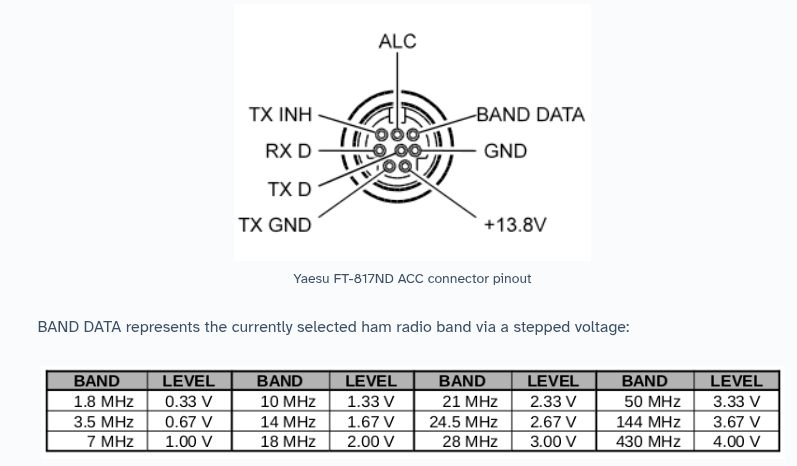
The three pins that matter for an amplifier are TX GND, BAND DATA and GND. TX GND is pulled to ground during transmit, so it doubles perfectly as the PTT keying line.
What makes the FT-818 special is BAND DATA: it is a single stepped analog voltage, one level per band. Amplifiers that read this legacy Yaesu scheme (the Micro PA 50 among them) can therefore follow the FT-818’s band automatically:
| Band | Level | Band | Level | Band | Level |
|---|---|---|---|---|---|
| 1.8 MHz | 0.33 V | 10 MHz | 1.33 V | 21 MHz | 2.33 V |
| 3.5 MHz | 0.67 V | 14 MHz | 1.67 V | 24.5 MHz | 2.67 V |
| 7 MHz | 1.00 V | 18 MHz | 2.00 V | 28 MHz | 3.00 V |
| 50 MHz | 3.33 V |
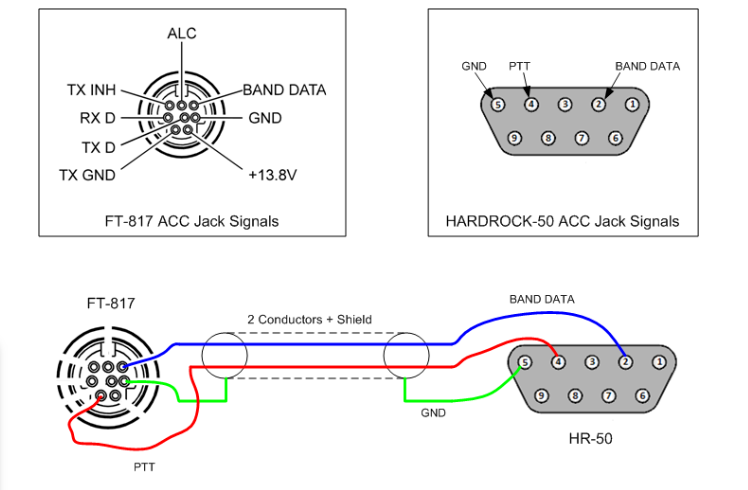
Use screened cable — two conductors plus shield is plenty. The wiring below routes PTT, BAND DATA and GND from the FT-817/818 ACC port to a DB9-style amp (a Hardrock-50 here); it’s a useful reference for the general layout:
FT-891 & FT-991 — PTT + ALC (manual band)
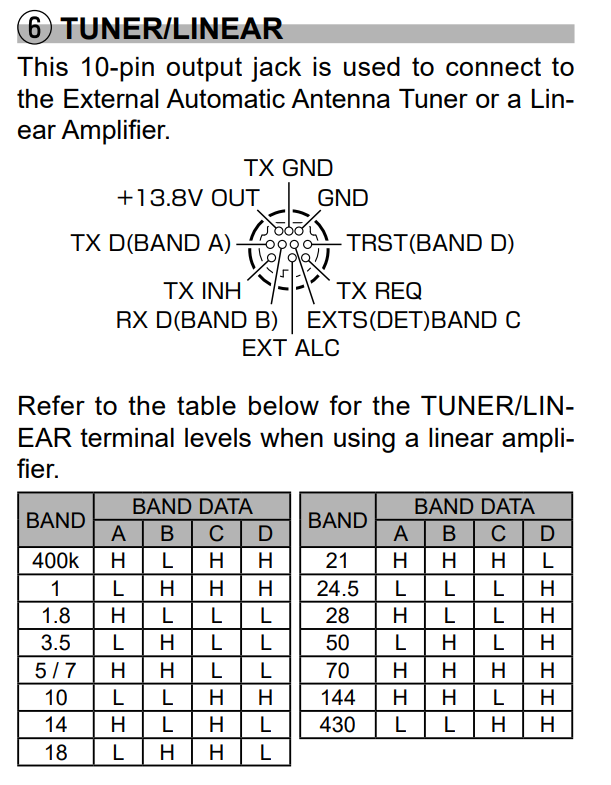
The FT-891 and FT-991 do not output the single analog band voltage the FT-818 does. Their band information is digital (BCD BAND A–D lines, see the FT-991 TUNER/LINEAR jack below), so unless your amplifier can decode BCD you leave the band lines alone and select the band manually on the amp. On these radios you wire two things: PTT keying and ALC.
PTT keying comes from TX GND + GND, exactly as on the FT-818.
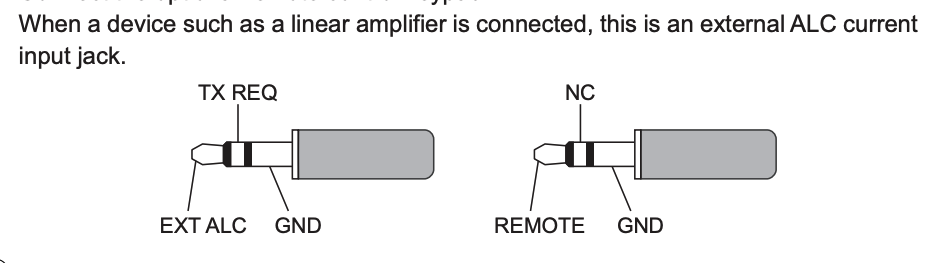
ALC goes on its own cable: a mono 3.5 mm plug from the transceiver’s ALC output to the amplifier’s ALC input. If your amp uses the common twin-RCA keying convention, the red phono plug is the relay/key line and the white plug carries ALC voltage back from the amplifier. On the FT-991 the ALC and TX-request lines appear on a dedicated rear jack:
For reference, the FT-991’s full 10-pin TUNER/LINEAR jack (which carries the digital BAND A–D lines and EXT ALC) looks like this:
FTX-1 — 10-pin Mini-DIN
The FTX-1 uses a 10-pin Mini-DIN and, like the FT-891/FT-991, sends digital band data — so again, key PTT and set the band manually on the amp. What the FTX-1 gives you cleanly is a dedicated EXT ALC pin right on the same connector:
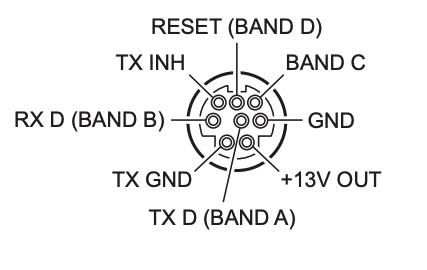
Typical wiring to an amplifier with a PTT jack and an ALC input:
| FTX-1 pin | Amplifier connection |
|---|---|
TX GND |
PTT |
GND |
GND (PTT return) |
EXT ALC |
ALC input |
GND |
GND (ALC return) |
TX GND grounds on transmit to key the amp; EXT ALC feeds the amplifier’s ALC back into the radio so it can throttle drive if the amp starts to overdrive. Band selection stays manual.
Worked example: Micro PA 50
The Micro PA 50 is a compact 50 W HF/6 m amplifier, and it’s a good illustration of how the choice of radio changes the cable. It takes all of its control on a single 3.5 mm (1/8") TRS plug — and note that there is no ALC line, only PTT and band:
| Position | Signal |
|---|---|
| Tip | PTT — pull to ground to key the amp |
| Ring | BAND — analog band-select voltage |
| Sleeve | GND |
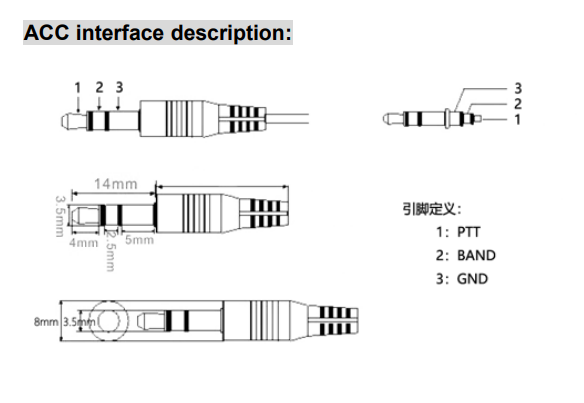
The amp’s BAND pin expects the analog stepped voltage from the table above — the same scheme only the FT-818 speaks natively. So:
- From an FT-818: wire all three.
TX GND→ tip (PTT),BAND DATA→ ring (BAND),GND→ sleeve. You get automatic band switching. - From an FT-891, FT-991 or FTX-1: their band data is digital and the Micro PA 50 can’t read it, so wire
TX GND→ tip (PTT) andGND→ sleeve, leave the ring unconnected, and set the band manually on the amp. There is no ALC connection to make on the Micro PA 50.
Summary
| Radio | Connector | PTT line | Band switching | ALC |
|---|---|---|---|---|
| FT-818 / FT-817ND | 8-pin Mini-DIN | TX GND |
Automatic (analog BAND DATA) |
— |
| FT-891 / FT-991 | Rear ACC + ALC jack | TX GND |
Manual (digital BCD) | 3.5 mm / RCA to amp ALC |
| FTX-1 | 10-pin Mini-DIN | TX GND |
Manual (digital BCD) | EXT ALC pin |
The one takeaway: only the FT-818 band-switches an analog-band amplifier like the Micro PA 50 automatically, because it still uses Yaesu’s legacy analog band-voltage line. Everything newer keys PTT the same way but leaves band selection in your hands.
Reference discussion: How to make amplifier key by — FT-891 group (groups.io)